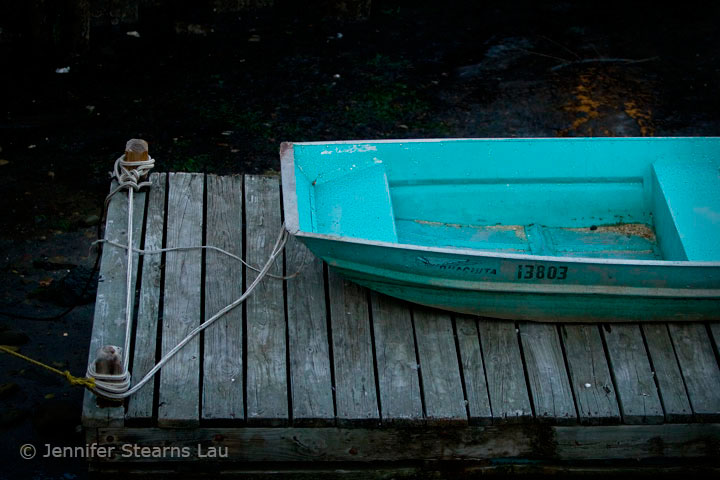
“The Green Pram” —a photo by Jennifer Lau

jennifer-lau-green-pram

My fellow Firefly artist-photographer, Jennifer Lau, is currently exhibiting her work at The Wine Cellar on Main in Northport, NY (70 Main Street). Among her photos is a series of small boat images, one of which caught my eye. This green pram is striking because of is simplicity, form, and color.

First, the simplicity—one boat, one dock. The background is dark which eliminates visual clutter. We don’t see the whole boat. No need to. It makes its presence known without monopolizing the composition. Cropped so, it balances with the dock in terms of visual proportions.

In terms of form—The shapes and lines are very pleasing, harmonic in a way. There are two primary vertical lines and one horizontal line, all three of which visually stabilize this photo. The rope on the left, strung taught between the two dock bollards like a guitar string, and the bow of the pram are vertically parallel. The horizontal lower edge of the dock “grounds” the image. The rhythm and repetition of the parallel dock planks contribute to the overall harmony.

Use of color—Other than the green pram, this image is primarily monochromatic. Coupled with the simplicity of the composition and harmonic play of lines, the color adds balance, interest, and pull.

To see more of Jennifer’s work, visit The Firefly Artists gallery at 180 Main Street or, until  January 6, 2015, The Wine Cellar on Main.


“Lighthouse Café” —a social arrangement

Lighthouse Café

Early one spring several years back, I was arranging a barbecue on Wincoma Beach, Huntington, NY, near my sister’s home. We were inviting some artist friends from Connecticut, Long Island, and New Jersey. I wanted to show them the view before their arrival.

This photo emerged after two evenings of shooting, the last evening using a tripod. I wanted the light reflections of the lighthouse and the red buoy to appear in the photo. However, they were out-of-sync, so i needed to leave the lens open for awhile—30 seconds was sufficient. It all worked out, for the shot is at dusk—low light—which requires a long exposure. A long exposure meant a small aperture. This in turn resulted in great depth-of-field—sharp focus from the foreground to background. AND, I got my two reflected columns of light.

I like this photo primarily because the three chairs face one-another in a magical setting. I’ve seen dozens of paintings and photos of a single sea-side chair facing the water. This is always a contemplative, reflective, introspective type shot, one I’ve always appreciated. But what sets this image apart is the communal arrangement of the chairs. It creates more of a social setting.

The horizon reveals the Connecticut shoreline. The lights on the horizon are those of Norwalk, CT. The land spit on the top left is Lloyd’s Neck.

Because of the social placement of the three chairs and the appearance of the Huntington Lighthouse, I named this photo, “Lighthouse Café.”

Thursday Night Lights—a painting compared to photography

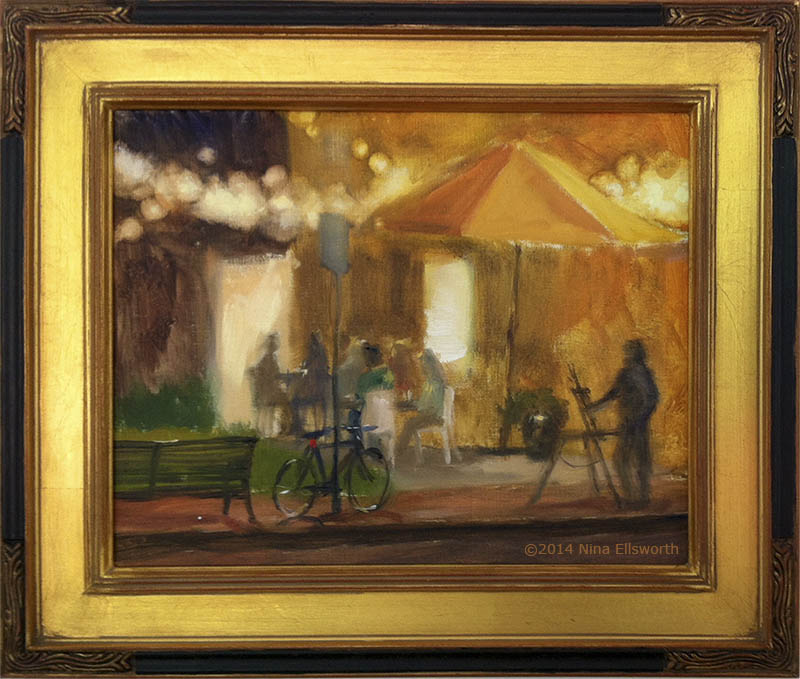
Nocturne—First Place at the Maryland Federation of Art, June 2014.

This oil painting, by Nina Ellsworth, grabbed my attention because of an idea I’ve been thinking about regarding interpretive work. Much of the photography I’ve been doing over the years has been literal. Recently, I’ve started exploring more impressionistic pieces, sometimes bordering on abstract. Abstracts do evoke feelings because of color, form, and intrigue as where the image came from. My sense, however, is that I’d prefer to give a hint of what the image is, or in what context the photo was shot.

For me, Nina achieved that with this painting. The majority of this rendering is impressionistic, blurry, “out-of-focus,” except the bicycle. It is the sharpest element in the painting and anchors me to a reality. Photographers do the same thing. When one or two elements, ever-so-small, are in sharp focus, while the rest is soft, out-of-focus, an image is rendered as somewhat impressionistic, or interpretive. This can be achieved with large apertures that lend shallow depth-of-fields coupled with selective focusing. Or it could be the use of shooting through rainy windows, photographing reflections, or using long shutter speeds so moving elements become blurry. Of course, some of this can be achieved via post-processing in photo-editing tools.

In Nina’ s painting, she’s got what photographers call bokeh, blurry background, scenes beyond the lens’s depth-of-field. I really like that—look at the string of lights across the top! And look at the shadowy silhouette of a plein-air painter.  In photographer’s terms, this painting has very shallow depth-of-field. The bicycle is the sharpest. Everything beyond it is impressionistic in varying degrees.

And as a complement, the warmth of the painting generated by the incandescent lights is enhanced by the golden frame—a beautiful piece.

No wonder it sold!