Shadows as key elements in photo composition

As photographers, sometimes we overlook shadows as key elements of composition.

Claude Debussy said, “Music is the space between the notes.”  Mozart said, “The music is not in the notes, but in the silence between.” Truman Fisher, an American composer, said, “The pause is as important as the note.”

Photographers read the light; follow the light. Derived from Greek, the word photography means “drawing with light.” But we must also read the shadows. For often it may be the spaces “not in light,” or in the “pause in light,” that impact an image.

Continue reading “Shadows as key elements in photo composition”

“Heading Home” a sunset with foreground elements—visual balance and technique.

Onboard the Schooner Olad returning to Camden harbor.

Many photographers, new, amateurs, and some professionals, shoot sunrises and sunsets—nature at its most beautiful if you are facing east or west at the right hour. That includes me! Sun-up and sundown photos proliferate the social media. Why not? The photographer is sharing a special moment that he or she witnessed. It’s a grand feeling.

The reason I’m showing this photo is because it IS a sundown, but, there’s something going on in the foreground. I believe that is important, although not always necessary. Why? It adds to the storyline. It helps put the photo into a context.

To increase the contextual impact of a photo with the sun setting or rising, consider including a telling foreground. In this case, it is the bow of the schooner Olad, a 50-foot vessel out of Camden, ME.

I shot photos for an hour as the sun descended and infused the sky with beautiful colors. I tried from various parts of the vessel, all with the idea of capturing some aspect of the vessel in the foreground. This was it. When I clicked the shutter, my senses resonated as they often do when I get a good shot.

I believe this shot works because of the triangular balance of shapes in the left and middle. The two sails you see are headsails, one free flying, the other on a self-tending boom. Coupled with the boom, the three forms are triangular, which also repeats the theme of three, there being three forms (similar to a pin-wheel).

Without the bow and sails, this would be a nice sunset photo. If it existed, I’d probably crop half the water so the horizon was even lower. But having the three elements, proportionally balanced in the foreground, takes this mage up a few notches in terms of interest and engagement.

_______________________

Technical variables: There are at least two variables that challenge a photographer to attain well-exposed and sharp sunrise or sunset photos with foreground elements—low light conditions and distance between subjects (foreground to infinity). The sky usually requires a different exposure than the foreground unless you are happy with foreground silhouettes, which often work great. If you want everything in focus, you’ll need a small aperture to span the distance from near to far, thus allowing the greatest depth-of-field. Now you either have to use a tripod for a longer exposure or increase the ISO substantially. Increasing the ISO on some cameras creates visual noise in the image unless you have a camera with a relatively large sensor.

Technical details: This shot was taken using a Nikon D7100 at 1/25 sec and ƒ 1/16. ISO was set to 640. Focal length on my Nikon 24-120mm lens was set to 24mm which translated to 36mm being on a camera with an APS-C sensor (1.5x crop factor). Despite my care in balancing the settings, I still needed Adobe Lightroom to open up the shadows on the foredeck and sails and reduce some highlights in the sky.


Strength, light, and balance—about a Jeff Urquhart photo

Urquhart-bridge

What are we looking at?

It may take a moment to figure that its the underside of a bridge, in this case, the Robert Moses Bridge on the south shore of Long Island, near Captree Island. It was shot by a photographer friend, Jeff Urquhart.

What strikes me first about this image is the abstract symmetry. I’m intrigued by the repetition of overhead arches leading to the foggy “light” down the center. Three colors—granite,  blue-green, and red-orange, interplay well with the overall form and design.

This photo is well composed and exposed. It has a medieval and cathedral-like appeal that shows strength, light, and balance, all of which happen to be desirable human attributes.

Thanks for letting me share this captivating image, Jeff.

The Angel in the Witch — the healing power of a photograph

by John Todaro
“Witch-Hobble” by John Todaro

This photo is an oxymoron. A “good witch,” or as the title says, “the angel in the witch.”

Long ago people claimed the witch-hobble growing around one’s home would protect them from witches because they could not walk through it. Anyone who tried to walk through a witch-hobble thicket, would thenceforth be endowed with powers of a witch. (According to Ellen Rathbone, an environmentalist and naturalist.)

My focus, however, is on photographer, John Todaro’s brilliant composition of two witch-hobble leaves and what their power has done for me. I’ve been in a creative doldrum for several months because of personal reasons. Upon seeing this photograph, I was creatively lifted to a place where I could again appreciate pristine aesthetics.

Initially, I saw refined design in this composition—a balance of tonality, rhythm, repetition, variation of form, and simplicity. I especially like the apex on the left leaf duplicated in reverse by the convergence of the two leaves above their overlap.

The dual vertical light spheres directly above the leaves’ convergence, coupled with the overlap (or “lens” shape) atop a triangle represents to me, a beautiful totem composition.

But what did I see beyond the pleasing composition?

I saw an angel with a halo, spreading her wings. That’s probably what I needed to see and feel, for afterward, I felt rejuvenated and got right back to attending my creative spirit. My doldrums have dissolved, thanks to a conscientious, well crafted black-and-white photograph by my friend and fellow photographer, John Todaro.

“Pleasantly lost in a forest” —nature’s parallels and the magic of synchronicity

We know nature yields beautiful patterns, some of which have been an inspiration to artists for years, decades, and centuries.

Many patterns mimic themselves—for instance, wave patterns in wet sand, the ocean, and in cloud formations. Or branching patterns seen in trees or tributaries—whether in a river delta or in a tidal-pool run-off.

In early October, I visited the Firefly Artists Gallery (where I am now a member) and was smitten by a pendant crafted by Kate Sidney, a jeweler and one of the founders of the gallery.

j-ellsworth-labradorite-pendant
“Pleasantly Lost in a Forest” —a Labradorite pendant by Kate Sydney

I was intrigued by the deep blue color and the branching pattern. I told her when I saw  the piece, I felt, “pleasantly lost in a forest.”

Two months went by and every time I entered the gallery, I was drawn to it. It did not occur to me to buy it. I simply wanted to appreciate it. Then on the evening we kicked off our “100 for $100” holiday promotion in early December, a woman in attendance, Caren Jacobs, suggested I try it on. I did—then I bought it!

Kate kept it for me until we could settle on a necklace chain. We decided on simple black leather.

Labradorite is considered a stone of magic and transformation. It’s a stone that brings you the gift of serendipity and synchronicity—being in the right place at the right time. Such coincidences supposedly occur more often if you wear this stone. It is also considered a crystal that will help provide clarity and insight into your destiny. The crystal commonly has a blue to green palette in values of dark and light, all of which varies by the ambient light.

During the course of the next two weeks, I was fortunate to sell a large photo on canvas, “Lone Visitor,” a single blue-morpho butterfly in a rain forest.

j-ellsworth-blue-morpho

I showed it to Kate and she noted the wings look like my Labradorite pendant. Whoa! How amazing—such a coincidence!

Was the magic of the stone playing out? It certainly seems as if serendipity and synchronicity intercepted me the last month of 2014.


“Sagittarius Fire” —Zodiac sign November 22 – December 21

Sagittarius Fire

The sun transits Sagittarius (the Archer)
between November 22 and December 21.

According to astrological belief, Sagittarius,
as well as Aries and Leo, are considered fire signs.
Generally,  people with these signs search for things
that light them up, that create passion. They are
prone to sudden flashes of insight and enthusiasm.

This photo was taken in Montauk about 11:00 pm several summers ago in late August. The constellation Sagittarius is square in the middle. By connecting the stars and overlaying the mythological archer, this is what you get:

john-ellsworth-Sagittarius-fire-triptyk

The Sagittarius artwork was created by Johan Meuris and accompanies Stellarium, the free and open source planetarium software. The image was released under The Free Art License. My son, Nick, helped me take the photo.

The silhouettes backlit by the moon river initially drew me to the scene. We shot it in color with a four-second exposure, camera on a tripod. I converted it to black and white and retained the amber of the fire and the glow on the faces. It was only after I produced the image that I figured out the prominent constellation hovering above the gathering.

“Island Loo” at Frenchman’s Caye, Belize—the simple life

john-ellsworth-island-loo-imagetalk

In 1972, I sailed with three friends to Belize and Guatemala from Florida on a 45-ft ketch, the Thai. It was owned and skippered by Ed Valier of Ft. Lauderdale. The vessel was a wooden Stonington.

After visiting Lago Izabal in Guatemala, we replenished in Livingston. Upon leaving Livingston, we visited an island called Frenchman’s Caye, just off the coast of Punta Gorda, Belize. It was owned by a former Navy underwater demolitions expert (frogman), Richard “Dick” Moore.

Dick was considered the first real underwater SCUBA diving pioneer in Belize. He settled on Frenchman’s Caye after living in the Yucatan and diving the shipwreck “Matanceros,” a Spanish galleon that was apparently bound for the New World from the Old World.

Dick ran a successful diving business from Fenchman’s Caye, throughout the Great Honduras Reef during the 1960s and 1970s.

He owned the entire island and enjoyed the luxury of “spreading out”—He scattered all of his living stations over the whole island.

This photo is of Dick Moore’s island washroom, thus “Island Loo.”

Thai was moored at Frenchman’s Caye for about three days before getting underway for Placencia Cove, Belize.

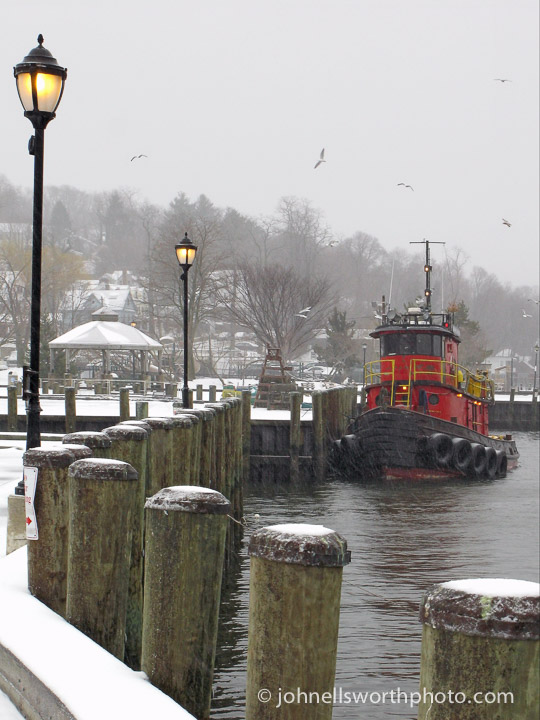
“Visitor in Red” —a photo as enduring as a tugboat

Visitor in Red

When I photograph, I work a shot from many angles until I get a “sensation” that when I press the shutter release, I captured the spirit of the scene that originally caught my attention. I don’t analyze each composition as I frame a shot. It’s more intuitive. It’s more by “feel.” And if I choose to print an image, it’s rare that I know an image has staying power. So when I first printed “Visitor in Red,” I made it a limited edition of 8o, in addition to a few artist’s proofs.

This scene was shot the day before St. Patrick’s Day (2007) in Northport, NY. I was walking my dog in the park about mid-day as it started to snow. I heard and felt a subtle rumbling. I turned my eyes to the harbor. This red tugboat was making its way toward the docks. I put my dog in the car, got my camera, and photographed the tug for about 40 minutes as it maneuvered to tie up and settle in. I got all angles, but this is the one I chose to produce.

After seven years, the photo still sells. Like a tug, the image has pulling power. I’ve heard from viewers they had a red tugboat as a child. Or their grandfather worked on tugs. Or they love Northport and this is a scene they’ve never witnessed. And so forth.

In my constant search to understand why an image resonates with some of us, I’d like to explore the composition and give a shot at interpreting it.

Composition

Color. With the exception of the red tug, the color palette of this photo is subdued green, brown, and yellow. This lends for a dramatic contrast imparted by the tug.

Leading lines. Implied lines are those created by visually connecting like elements as if one were “connecting the dots,” or stars in a constellation. I see three series of lines in the photo. One set, the pilings, directs your eyes to alongside the tug. The lit lanterns, from left to right, take you directly to the tug. All this under the four seagulls, which if “connected,” cups the scene, as if a visual canopy.

Balance. Although the tug is off to the right, it is visually balanced by the receding line of the lanterns’ yellow glow. I don’t think I’d get the same sense of equilibrium had the lanterns been off.

Interpretation

It’s probably what a tugboat represents that contributes to the appeal of this photo. There’s authenticity in the design of a tug. They are designed and built for utility. Function trumps fashion, trend, or vogue, to the point where “utilitarian” becomes an attractive look itself (as long as it’s for real).

A tug is designed to pull and push large barges and ships in all kinds of weather. Its purpose requires dedication, reliability, strength, persistence, and a courageous crew—all traits we respect and perhaps identify with.

A simple portrait of a moored tugboat may evoke similar interpretations. But I think such a portrait needs to be in an interesting composition, or visual milieu, to render an image as enduring as the tug itself.

“Remember When” —reflections on derelict images

Remember When

Occasionally I like to photograph scenes that feature derelict elements. I don’t know why. I can only speculate. Time worn? Stories to tell? Withstanding the elements? Maybe it’s because I’m in my later years, but then again, I have photos of such scenes I shot when I was in my late twenties—especially old boats, vehicles, houses, sheds, and barns.
Nevertheless, I had to capture the front porch of this house in Pioneerville, Idaho, a few autumns back. Pioneerville is a ghost town about 55 miles by road, northeast of Boise. It was a mining town during the late 19th century. The scene spoke to me. But what was it saying?
I think, “transience.” Here today, gone tomorrow (or years from now). Despite having emotional ties to our loved ones, our homes, our cities, and our countries—it never lasts. Either we depart, or the relationship in which we love dissolves. It’s as if we are visitors in time. What we do hold onto, though, are memories.
For some, that’s all we’ve got of what once was. And that’s why memories are treasured.